
If your content isn’t showing up inside AI answers, you’re already losing visibility—even if you rank #1 on Google. This is the shift in search behavior that is changing faster than SEO playbooks can adapt. With AI engines like ChatGPT and Google’s SGE synthesizing information directly into answers, the traditional SEO model of driving clicks through search results is under threat.
The phenomenon of zero-click searches is being amplified by AI, which users trust more for synthesized answers over traditional links. While traditional SEO focuses on achieving visibility, Generative Engine Optimization (GEO) aims for inclusion in the answer layer. The key distinction here is that while Google ranks pages, AI engines assemble answers.

What is GEO (Generative Engine Optimization)?
GEO is the practice of structuring and distributing content so AI models can find, trust, and reuse it in generated responses. It is not about optimizing for search engine rankings but rather for AI retrieval and synthesis systems. GEO covers an array of platforms including ChatGPT, Perplexity, Google SGE, and Claude, which are at the forefront of AI-driven search experiences.
The core of GEO is built on three pillars: retrieval, interpretation, and attribution. Retrieval ensures that AI can find your content; interpretation determines whether AI can understand it; and attribution involves AI citing or reflecting your content in its generated answers. This transformation is crucial because it aligns content strategy with how AI systems actually operate.
GEO vs SEO — The Real Difference
To grasp the differences between GEO and SEO, it’s vital to look beyond surface-level comparisons. GEO and SEO diverge across four critical layers: keywords to intent clusters, ranking to inclusion in answers, backlinks to authority signals and citations, and page optimization to entity and knowledge optimization.
While SEO focuses on optimizing for algorithms that rank pages, GEO is about optimizing for models that generate answers. This shift means moving from targeting specific keywords to understanding and addressing broader intent clusters. It’s no longer sufficient to rank; your content must be included in the AI-generated answer layer to be effective.
Authority in GEO is built through signals and citations rather than mere backlinks. Moreover, the focus shifts from optimizing individual pages to ensuring that entities and knowledge are well-represented and understood by AI models. This represents a fundamental change in how content is crafted and recognized by search systems.
How AI Engines Actually Work
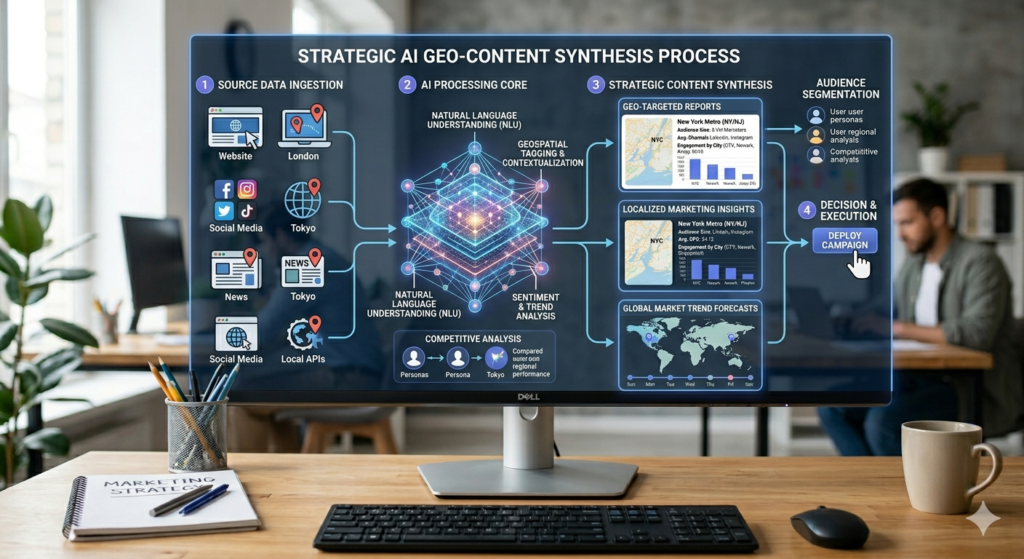
Understanding how AI engines work is essential to mastering GEO. The pipeline of AI processing involves several key stages: query understanding, retrieval, ranking, and generation. In query understanding, the AI interprets both the intent and context of the user’s question.
Next, during retrieval, documents are pulled using embeddings or vector search, which are more sophisticated than traditional keyword searches. Ranking then assesses relevance and authority, determining which pieces of content are most suitable to include.
Finally, during generation, Large Language Models (LLMs) synthesize the answer. It’s crucial to realize that if your content is not retrieved, it does not exist for the AI. If your content is not clear, it won’t be used, and if it lacks authority, it won’t be trusted.
Core GEO Ranking Factors
The core ranking factors for GEO can be framed as a systematic approach rather than a collection of tips. These factors include semantic clarity, entity strength, topical depth, authority signals beyond backlinks, and structured content for retrieval.
Semantic Clarity
Clear headings, direct answers, and structured explanations are mandatory. AI prefers extractable content blocks, so eliminating fluffy introductions and focusing on substance is critical.
Entity Strength
Brand mentions across the web, consistent positioning, and association with topics are essential. You’re not ranking pages; you’re building entities that AI systems recognize and trust.
Topical Depth (Not Length)
Content should offer multi-angle coverage, first-principles understanding, and advanced insights, supported by real examples. Thin content will be ignored in retrieval processes.
Authority Signals Beyond Backlinks
Citations, mentions in trusted sources, and author credibility are paramount. AI leans toward information that is backed by consensus and authority.
Structured Content for Retrieval
Lists, FAQs, and summaries with clean formatting are crucial. While schema still matters, clarity is more important for retrieval.
Content Formats That Win in GEO
To thrive in GEO, specific content formats are more effective than others. Winning formats include “explained simply” sections, step-by-step breakdowns, definitions with expansions, comparisons, and FAQs that mirror real user queries.
Conversely, story-heavy intros, opinion pieces without structure, and keyword-stuffed blogs are less effective. The goal is to create content that is easily extractable and understandable by AI systems.
GEO Content Framework
Creating content for GEO involves a repeatable system that ensures alignment with AI retrieval methods:
Step 1: Intent Mapping
Identify the exact question AI is trying to answer and tailor your content to meet this need directly.
Step 2: Answer-First Writing
Begin with a direct answer to the question, then expand with additional insights and details.
Step 3: Layered Depth
Offer content that transitions from beginner to intermediate to expert levels of detail.
Step 4: Structure for Extraction
Use headings as questions and paragraphs as concise answers to facilitate easy extraction by AI.
Step 5: Reinforce Authority
Incorporate statistics, examples, and a unique point of view to bolster credibility and authority.
How Do You Even Track GEO?
Tracking GEO success is inherently messy, but there are proxies available to gauge effectiveness. These include increases in branded search traffic, direct traffic growth, mentions in AI tools through manual testing, overlap with featured snippets, and content being paraphrased in AI-generated answers.
These metrics provide insight into how well your content is performing within the GEO framework, even if traditional metrics are less applicable.
Common Mistakes
Many practitioners fall into the trap of writing SEO blogs and mislabeling them as GEO content. This includes ignoring the need for structure, failing to provide original insights, over-relying on keywords, and treating AI as a search engine rather than an answer engine.
These common missteps can severely undermine the effectiveness of your content strategy in an AI-driven search environment.
Future of GEO in Digital Landscape
The future of GEO suggests a decline in traditional clicks, blurred attribution lines, and compounded authority. Brands that position themselves as “source material” will thrive, while those that fail to adapt will become increasingly irrelevant in the answer layer.
This shift underscores the importance of evolving content strategies to align with the processes and preferences of AI retrieval and synthesis systems.
Final Verdict
Generative Engine Optimization demands a confluence of content, structure, and UX thinking. Many brands falter because they approach it solely as content writing. The challenge with GEO is its invisibility—traditional SEO tools cannot track AI-generated response influence.
Tools like Vyndow are designed to bridge this gap, offering a clearer view of your presence in AI-driven search experiences. This insight is crucial for brands looking to maintain and grow their visibility in an evolving search landscape.
Further reading:
GEO audit factors — Reference GEO audit metrics
using AI for SEO success — Discuss AI’s role in SEO
People Also Ask:
Q1. How does GEO differ from traditional SEO?
A1. GEO focuses on optimizing content for AI retrieval and synthesis, ensuring inclusion in AI-generated answers, while traditional SEO targets search engine rankings. GEO emphasizes intent clusters, authority signals, and entity optimization over keywords and backlinks.
Q2. What are the core pillars of GEO?
A2. The core pillars of GEO include retrieval, interpretation, and attribution. Retrieval ensures AI can find your content, interpretation verifies AI understanding, and attribution involves AI citing or reflecting your content in its responses.
Q3. How can brands measure GEO effectiveness?
A3. Measuring GEO effectiveness involves tracking proxies like branded search increases, direct traffic growth, mentions in AI tools, and content paraphrased in AI-generated answers. Traditional SEO metrics may not fully capture GEO success.
Q4. Why is authority important in GEO?
A4. Authority is crucial in GEO because AI engines prioritize consensus-backed information. Content with strong citations, mentions in trusted sources, and credible authorship is more likely to be included in AI-generated answers.
Q5. What content formats are effective for GEO?
A5. Effective content formats for GEO include “explained simply” sections, step-by-step breakdowns, and FAQs that mirror real user queries. These formats facilitate easy extraction and understanding by AI systems.



2 thoughts on “Generative Engine Optimization: Navigating the Future of Search Visibility”
Comments are closed.