Beyond the Text: Mastering On-Page SEO in 2026
In the evolving landscape of SEO, focusing solely on the words within your content is no longer enough. The real battle for search engine dominance includes mastering the technical aspects that support those words. This article delves into the often-overlooked “Invisible 50%” of SEO, highlighting the importance of structured data and metadata automation in achieving optimal on-page SEO in 2026. Vyndow SEO serves as the bridge between creative writing and technical execution, ensuring that your content is not just rich in quality but also technically sound.
Gone are the days when keywords alone could dictate your content’s ranking on search engines. As Google’s algorithms have advanced, the focus has shifted from mere keywords to understanding entities or concepts. Adding to this complexity is the necessity of automating metadata and schema markup to ensure your content stands out. Vyndow SEO offers a comprehensive solution to these challenges, facilitating a seamless integration of creativity and technical precision.
The Shift to Entities
The shift from keywords to entities marks a significant evolution in Google’s search algorithms. Entities refer to the concepts, people, places, or things that a piece of content discusses. This transition signifies that Google is now better equipped to understand the context and relationships within your content. As a result, focusing solely on keywords is inadequate for achieving high search rankings.
For example, consider the difference between the keyword “apple” and the entity “Apple Inc.” While a keyword might suggest a broad array of content ranging from fruit to technology, an entity provides a specific reference that Google can better interpret. This differentiation allows Google to deliver more accurate search results that match user intent.
In practice, this shift means content creators must adapt by incorporating entities into their on-page SEO in 2026 via appropriate strategies. Vyndow SEO aids in this transition by providing a platform that automatically recognizes and integrates entities into your content, ensuring that your material aligns with Google’s evolving expectations.
The Automation Gap
In the world of SEO, manual processes can significantly hinder scalability. One such bottleneck is the manual creation of meta descriptions and other metadata elements. As content demands increase, so does the need for efficient processes. Relying on manual input not only consumes time but also increases the likelihood of human error.
The automation gap arises when businesses fail to leverage technology to streamline these processes. Writing meta descriptions by hand may have worked in the past, but in today’s fast-paced digital environment, it is a considerable inefficiency. Automated solutions offer a way to close this gap, reducing the time and effort required to produce optimized content.
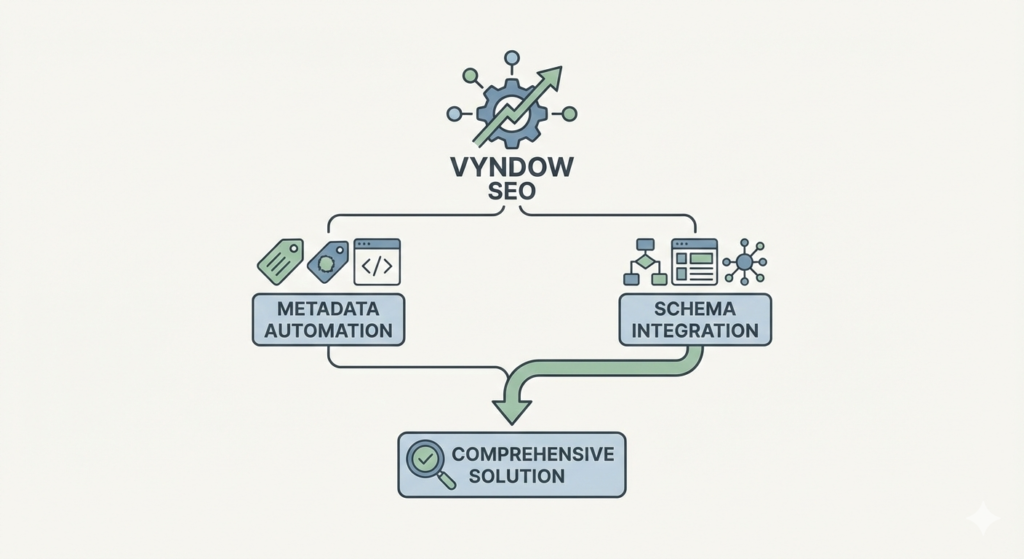
Vyndow SEO tackles this challenge head-on by offering metadata automation. This feature allows users to generate meta descriptions and other essential SEO elements with the click of a button, ensuring consistency and accuracy across all content pieces. By closing the automation gap, Vyndow empowers content creators to focus on the creative aspects of their work.
The Vyndow Solution: The Technical Last Mile
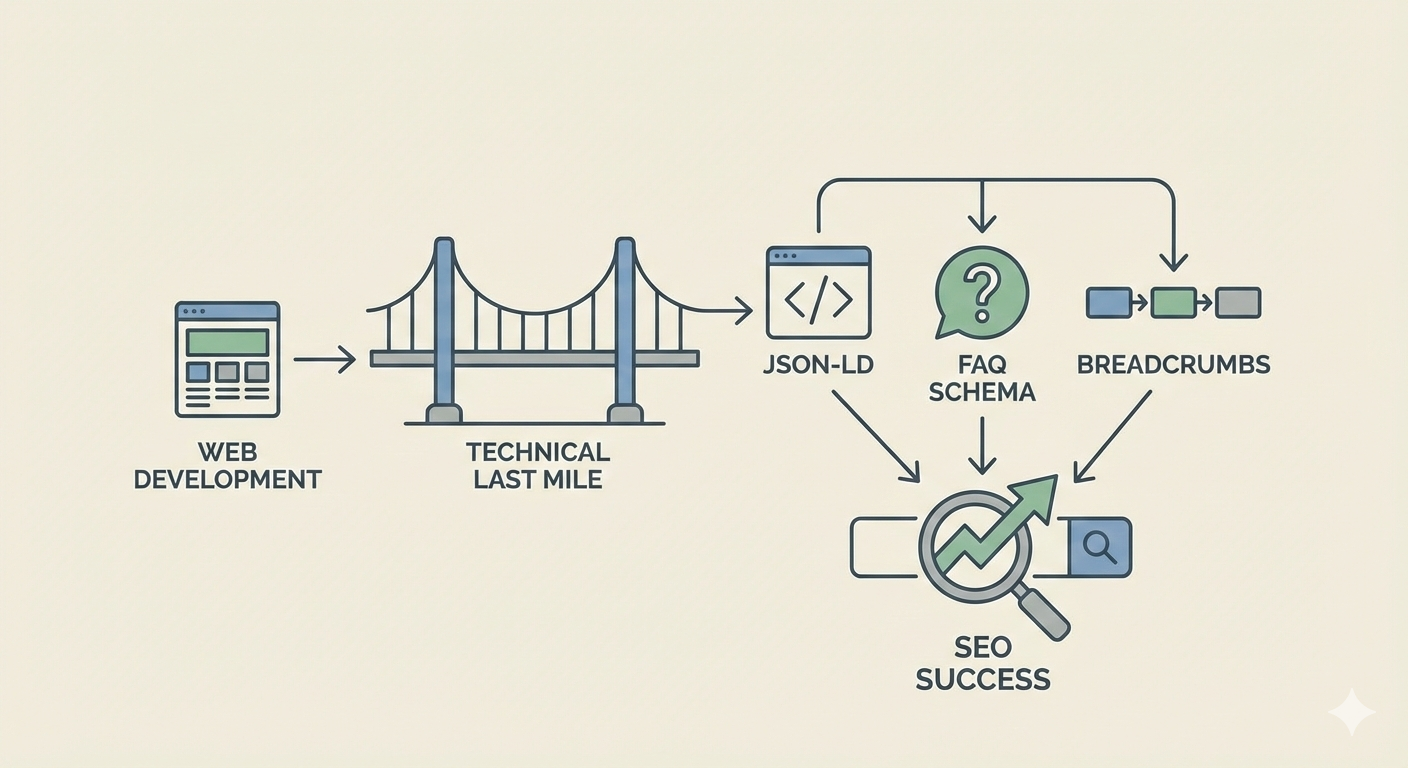
While many AI-driven tools focus primarily on crafting content, Vyndow SEO stands out by addressing the “Technical Last Mile” of the publishing process. This phase involves integrating necessary technical elements such as JSON-LD, FAQ schema, and breadcrumbs, which are often overlooked but crucial for SEO success.
JSON-LD is a lightweight data interchange format that enables Google to better understand and display your content in search results. FAQ schema enhances the likelihood of your content appearing in featured snippets, providing a significant visibility boost. Breadcrumbs improve site navigation, offering users a clear path to explore your content further.
Vyndow SEO automates the integration of these elements, ensuring that your content is not just well-written but also technically optimized. This comprehensive approach ensures that users can transition seamlessly from creation to publication, eliminating the friction that often accompanies the technical aspects of SEO.
ROI of Technical SEO
The return on investment (ROI) of technical SEO is often underestimated. Structured data, for instance, increases the chances of your content appearing in AI-generated summaries at the top of Google search results. These summaries, known as featured snippets, provide users with quick answers to their queries and significantly enhance your content’s visibility.
By integrating structured data into your content, you increase the likelihood of Google selecting your material for these prominent positions. This visibility translates into higher click-through rates and, ultimately, greater traffic to your site. In this sense, technical SEO becomes an investment that yields measurable returns in terms of both visibility and engagement.
Vyndow SEO’s automated schema markup capabilities ensure that your content is optimally structured for search engines, maximizing your chances of capturing these valuable snippets. The result is a more efficient and effective SEO strategy that delivers tangible results.
Brand Context: Vyndow as the Full-Stack AI Publisher
Vyndow SEO is more than just an AI writer; it is a full-stack AI publisher that bridges the gap between creation and technical execution. While competitors like Jasper and Writesonic focus on drafting content, Vyndow distinguishes itself by providing a complete technical package, ready for publication.
Vyndow’s mission is to eliminate the friction between creation and ranking by delivering content that marries human-grade brand voice with machine-perfect technical SEO. This approach ensures that content creators can focus on producing high-quality material without getting bogged down in the technical intricacies of SEO.
The brand’s core value proposition, the “100% Finish Line,” emphasizes the importance of delivering a complete product, from content creation to technical optimization. This comprehensive approach sets Vyndow apart in the competitive landscape of AI-driven content tools.
Target Audience: The Power User
Vyndow SEO is specifically engineered for what it terms the “Power User.” This audience includes niche bloggers, SEO agencies, and business owners who need to scale content production without compromising on quality or technical precision.
Niche bloggers, for example, can benefit from Vyndow’s ability to produce up to 50 posts a month without the need for a large editorial team. For SEO agencies, the platform reduces the per-post labor cost of technical optimization, allowing them to focus on strategy and client relations.
Business owners, who often possess industry knowledge but lack technical expertise, find Vyndow’s automation features invaluable. By eliminating the need for manual meta-tag and schema code input, Vyndow allows these users to focus on their core business activities.
Competitive Positioning and Brand Vision
In the competitive landscape of AI-driven content tools, Vyndow SEO distinguishes itself through its focus on publish-ready output. Unlike Jasper and Writesonic, which prioritize creative copywriting, Vyndow offers an end-to-end module that includes auto-generated schema, meta-data, and alt-tags.
This technical intelligence ensures that content is optimized for search engines from the outset, reducing the friction that can arise during the publishing process. Vyndow’s sophisticated voice-match engine also ensures that the content aligns with industry standards, maintaining brand integrity.
Vyndow’s vision is to become the global standard for autonomous SEO, representing a shift from AI-assisted writing to AI-driven publishing. This vision underscores the brand’s commitment to delivering a comprehensive, efficient, and technically sound solution for content creators worldwide.
FAQ :
Q1. How does the shift to entities affect SEO strategies?
The shift to entities means that Google now focuses on understanding the concepts within your content rather than just keywords. This requires content creators to integrate entities into their on-page SEO strategies, ensuring that their material aligns with Google’s evolving algorithms for better search rankings.
Q2. What is the automation gap in On-Page SEO in 2026 ?
The automation gap refers to the inefficiencies caused by relying on manual processes for creating metadata and schema markup. This gap can hinder scalability and lead to inconsistencies. Automated solutions like Vyndow SEO help close this gap by providing tools that streamline these processes, enhancing efficiency and accuracy.
Q3. Why is the “Technical Last Mile” important in SEO?
The “Technical Last Mile” involves integrating essential technical elements like JSON-LD, FAQ schema, and breadcrumbs into your content. These elements are crucial for SEO success as they improve search engine understanding and visibility. Vyndow SEO automates this integration, ensuring your content is technically optimized.
Q4. How does structured data enhance SEO ROI?
Structured data increases the likelihood of your content appearing in featured snippets, which are AI-generated summaries at the top of search results. This visibility boosts click-through rates and traffic, making technical SEO a valuable investment with measurable returns in visibility and engagement.
Q5. What sets Vyndow SEO apart from its competitors?
Vyndow SEO stands out by offering a complete technical package that bridges the gap between content creation and technical execution. Unlike competitors that focus on drafting, Vyndow provides auto-generated schema, metadata, and alt-tags, ensuring publish-ready output and reducing the friction in the publishing process.


3 thoughts on “Mastering On-Page SEO: The Power of Automated Schema and Metadata”
Comments are closed.